
Indonesia Earthquake Tsunami Warning : Major 7.4 Magnitude Tremor Strikes Eastern Region
A powerful earthquake struck Indonesia today, registering a magnitude of 7.4 on the Richter scale, prompting an immediate Indonesia Earthquake Tsunami Warning for the surrounding regions. The epicenter was located near the Molucca Sea, affecting several islands in eastern Indonesia, including Halmahera and surrounding coastal areas. Residents reported feeling the ground shake violently for several seconds, causing panic and forcing people to evacuate homes, schools, and offices. Authorities confirmed that the earthquake occurred at a depth of approximately 35 kilometers, which significantly amplified its impact on nearby communities. The tremor was widely felt in distant provinces, with seismic waves reaching as far as North Sulawesi and parts of Maluku.
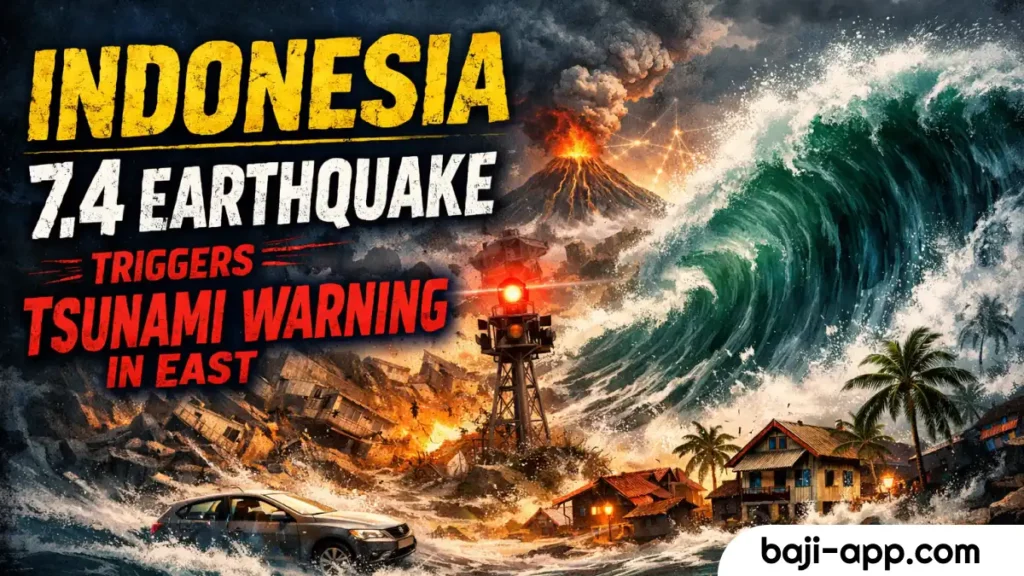
Indonesia Earthquake Tsunami Warning : Evacuations and Precautions
Following the earthquake, Indonesia’s Meteorology, Climatology, and Geophysics Agency (BMKG) immediately issued a tsunami warning for the coastal areas near the epicenter. The warning prompted mass evacuations along northern and eastern coastlines, with local authorities instructing residents to move to higher ground. Preliminary measurements suggested that small tsunami waves of up to 0.75 meters were detected in some areas, though no large – scale destructive waves were reported.
Emergency response teams coordinated with local governments to provide shelters, food, and medical aid for displaced residents. Authorities also broadcast warnings through social media, television, and radio, emphasizing that people should avoid low – lying areas until the all – clear was officially given. After careful monitoring, the BMKG eventually lifted the tsunami alert, confirming that immediate risks had subsided, but they urged residents to stay alert for potential aftershocks.
Damage Assessment : Impact on Communities and Infrastructure
Initial reports indicate that the earthquake caused structural damage in northern Maluku and nearby islands. Several buildings, including homes, schools, and small businesses, sustained cracks or partial collapses. At least one fatality was reported, while numerous injuries were documented, mostly due to falling debris or panic-induced accidents. Roads and bridges in some remote areas were temporarily blocked by minor landslides triggered by the tremor.
In addition to physical damage, residents faced psychological stress, as the sudden earthquake and tsunami warning caused widespread fear. Local authorities deployed emergency services, medical personnel, and disaster management teams to affected areas to assist with rescue operations and ensure essential services remained functional. Hospitals and clinics were placed on high alert to handle potential injuries, and community centers served as temporary shelters for displaced families.
Aftershocks and Ongoing Seismic Activity
Seismologists from BMKG and international agencies have confirmed that aftershocks are expected over the coming days. These aftershocks, while generally smaller than the main quake, have the potential to cause further damage to weakened structures. Experts highlighted the need for continued caution, advising residents to avoid returning to unsafe buildings and to follow evacuation routes even after the main quake.
Indonesia Earthquake Tsunami Warning : Indonesia’s location on the Pacific Ring of Fire makes it one of the most earthquake – prone countries in the world. Historical data show that the region regularly experiences high – magnitude tremors, often accompanied by tsunamis. Authorities continue to monitor seismic activity closely, employing advanced early warning systems to alert residents quickly in the event of another major tremor.
Experts also advised that schools and workplaces conduct emergency drills, and coastal communities remain vigilant in case of secondary waves or tsunamis caused by underwater landslides. Officials continue to assess the full extent of the damage and are coordinating with local governments to prioritize restoration of critical infrastructure, including roads, electricity, and communication networks.